Blendit!

Role
UI/UX Designer
Duration
8 weeks
Project Size
6 members
Type
Design @ UCI Project
Overview
Blendit! is a mobile app that dedicates users to build healthy eating habits by recommending personalized smoothie recipes.
Over 8 weeks, I immersed myself in end-to-end UX design, starting from user research, surveys, wireframing, and high-fidelity prototyping in Figma.
Introduction
Blendit! was born from a single prompt of food. This was the prompt given to us at the very start of our project.
With only 8 weeks to go from a blank canvas to a full product demo, our goal was to create something meaningful. A product that had the perfect blend of creative freedom, bridging the gap in how people approach health.
Problem
Understanding the Problem
We wanted to avoid jumping straight to conclusions, so we created a list of issues relevant to everyday tasks relevant to food. Our goal was to understand the full landscape before narrowing our focus. What are some societal problems in regards to food?
Narrowing the Problem
We realized a common pattern of problems regarding ingredient usage in pre-existing ingredients. This includes a lack of nutritional awareness, food waste and harmful additives in manufactured goods.
Emphasizing the power of mindfulness when it comes to food consumption, we tackled the following problems into probable solutions: providing nutritional knowledge, balancing the food costs and utilizing pre-existing ingredients in cooking.
“How might we aim to empower individuals with nutrition knowledge while being financially smart about utilizing pre-existing ingredients?”
Ingredients in Manufactured Goods
Many ingredients listed in manufactured goods are processed and ineligible without extra research.
Ingredient Optimization & Nutrition
Optimizing nutrition in food consumption reduces diseases including heart disease, diabetes and strokes.
Food Waste
The United States wastes nearly 120 billion pounds of food every year, ~40% of the entire U.S. food supply.
Deeper Levels of Thinking
Analogy Thinking
Our first initial concept — an app that allows users to input ingredients they already own through ingredients search and receiving matching recipes. It address the two core problem spaces of ingredient retrieval and the user's motivation to cook.
To sharpen our focus, we decided to narrow the broad food category to smoothies. Since smoothie ingredients are staple ingredients that most households already own (fruits, vegetables, liquids), we wanted to make the barrier of using the app at a low stake. Optimizing fresh ingredients, we also wanted to impact the improvement of physical health.
New Problem Space: How might we aim to empower individuals with nutrition knowledge and being financially smart with purchasing groceries and utilizing their existing ingredients
Opposite Thinking
After our new problem space, we began to wonder about the questions that may counter our main goals and functionality of our app.
Question #1
I'm lost and new to making smoothies. What should I put in my smoothies?
Solution #1
Let's make smoothie making simple and intuitive to navigate, especially for new users!
Question #2
I might lose my motivation to keep making smoothies. How can I make it fun?
Solution #2
Let's allow trial and error of creative smoothie making possible!
Our Purpose
Through our analogy and opposite thinking, three key focuses of our project became clear: Nutritional awareness, ingredient accessibility, and enjoyment.
After redefining our purposes and focusing on nutrition and enjoyment, we edited the once clustered problem statement into a new one.
"How might we aim to empower individuals with increased nutrition knowledge and make preparing healthy food using existing ingredients feel enjoyable?"
Research
Before jumping into design creation, we decided to research the potential user base to understand how each design decision would make sense to implement.
01.
Investigate the impact of gamification on user engagement and motivation in a smoothie making app.
02.
Understand how our target users relate to smoothie making, healthy living and what motivates them to do so.
03.
Uncover what users want from their health and nutritional goals.
Methodologies
To best meet our research goals, we used user surveys to understand behaviors and motivations and competitive analysis to map out already existing apps in the market.
We wanted to cross-reference what users said they wanted in the surveys against what already exists in the market to uncover potential gaps.
Surveys
Our target audience was young adults for our use case, considering the increasing mindset of being health-conscious, financially aware and balancing time. As the pressures of work and maintaining a healthy lifestyle starts to rise, we realized that smoothie making sat at the intersection of being quick, cost-efficient and flexible.
We surveyed 8 participants within the 18-34 age range.


75% of respondents showed a lack of frequency in making smoothies. Although their interest was low, 62.5% of respondents were still conscious about maintaining their health.

Respondents showed that they find smoothie recipes mainly through social media platforms including Instagram, Tiktok and Youtube, already encountering these platforms daily. Users didn't go looking for recipes deliberately, but it happened passively.
Competitive Analysis

Our competitive analysis revealed a gap of smoothie making apps already out on the market. They lacked a feature to track progress or gamification of any kind. This became an opportunity for our app to shine.
User Persona

After researching even further through competitive analysis and user surveys, we sharpened our target audience. We synthesized the findings into a user persona that captured our demographic: young adult who care about their health but is navigating across a busy life.
Low Fidelity Wireframes


Mid Fidelity Wireframes
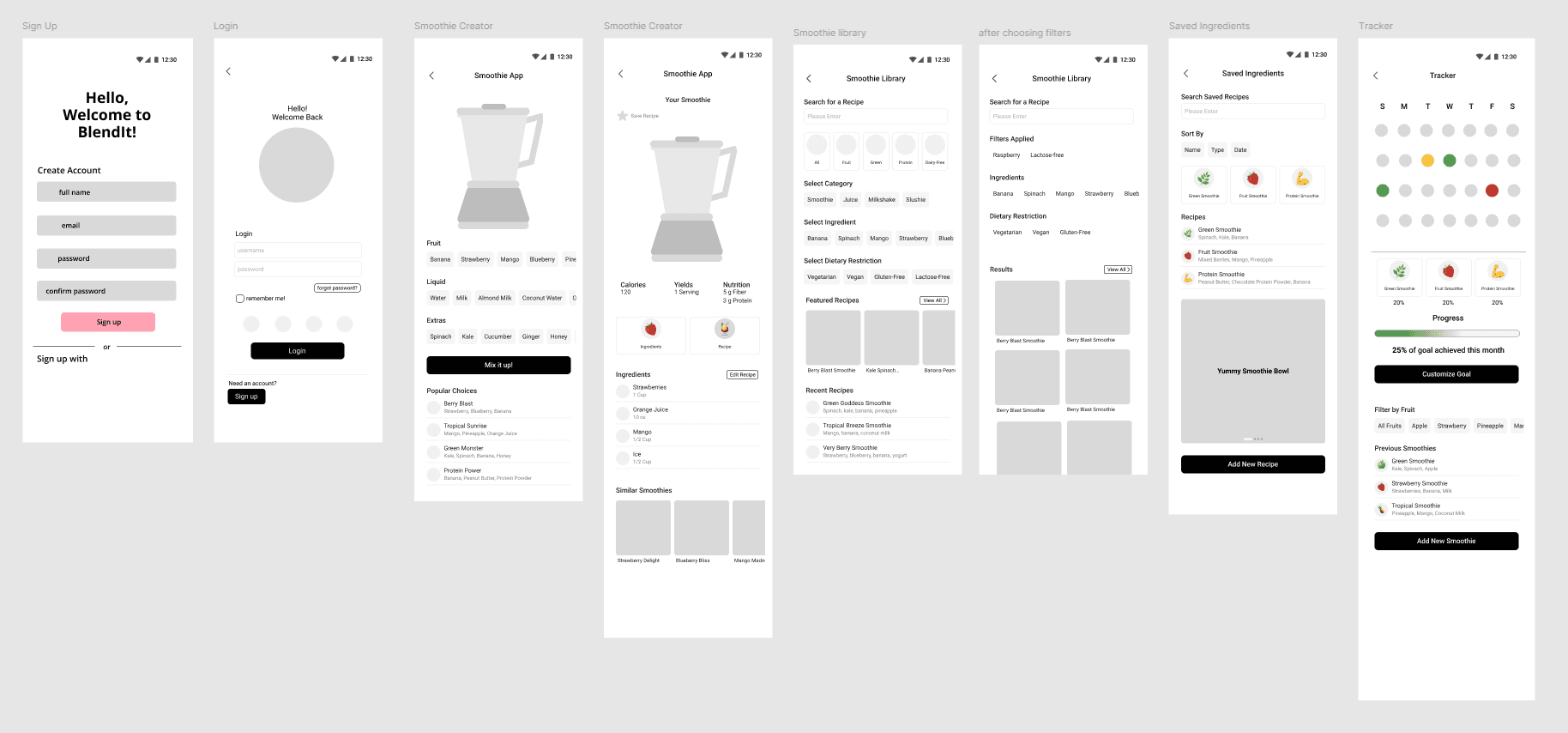
Building on our lo-fi sketches, we created the mid-fidelity wireframes in Figma.
Decisions solidified at this stage:
The blender became the centerpiece of the creation screen — interactive feature that users can visually interact with and see.
Ingredient filtering — filtering by category to give shape to personalization, allowing users to control.
Smoothie result output with nutritional benefit — letting the users aware of nutritional benefits and goals.
Progress feature — giving users a way to visualize their consistency.
UI Kit & Brand Style
Make healthy feel fun was the principle we followed from the start.
Blendit!'s brand identity was built around energy, fun, sweet, and tropical. We chose a pink, orange and green color palette to leave an emotional resonance of feeling energy. Out logo also leaned into playfulness to lower the barrier that comes with maintaining health. We wanted our brand to feel inviting for users to engage more, especially through our gamification features.
BlendIt!
Voice and Tone: Energetic, Fun, Sweet, Tropical


High Fidelity Testing & Feedback
To validate our high-fidelity prototype, we conducted a usability test with a participant matching our target, a young adult familiar with social media recipe discover and is conscious about maintaining health. We moved through core user flows including smoothie creation, recipe exploration, saved recipes, and progress tracking.
Finding 1 — Clarity on the Explore Page
Participant mentioned that the explore page was difficult to navigate, as the "View All" button was unclear in placement and visually.

->

Finding 2 — Gamification Validation
When asked whether the smoothie creation flow felt game-like, the participant had an overall positive response. They mentioned that the blend image building up and seeing the ingredients stack was visually engaging.
Takeaway: Gamification mechanic worked as intended.
Finding 3 — Positive Reaction on Progress Tracking
When asked which feature was the most important or functional to achieve their health goals, the participant pointed to the tracking feature with the stats bar and smoothie history.
Takeaway: This confirmed the positive outlook on the habit-tracking mechanic that could stand out compared to other competitor apps.
High Fidelity Prototype

Create a smoothie using ingredient selection
Users select ingredients directly inside the blender as the blender visually stacks with each ingredient. The result is recommended based on the combination chosen by the user. We wanted this mechanic to showcase visually enjoyable experiences, even through a screen.
Explore results using category selection
Blendit! filters results based on category selection and dietary restrictions, accommodating for a diverse user background. Giving users enough control but also feeling seen at the same time.


Save favorite smoothies into collection
This collection feature lets users save any smoothies of liking. Each smoothie displays the full ingredients list and nutritional breakdown. Our goal was to let the users know what they're putting into their body.
Track progress and nutrition intake
To motivate users, progress of smoothie consumption is tracked through a visual calendar. The calendar is color-coded to distinguish between smoothie type and nutritional intake for a clear picture.

Conclusion & Reflection
Although this was my first case-study project, our team placed second place out of eight total competing teams! I am extremely thankful to have worked with such an amazing team of six.
What did you learn?
After completing my first case study project, Blendit!, it felt as if I took my first steps into becoming a user-centric designer. I learned iterative steps, creative Mid-Fidelities and High-Fidelities with prototyping and wireframing on Figma, as well as conducting user-research to truly understand the core user base. This experience deepened my understanding of how important research is during a time-constraint framework, as we were given 8-weeks to start from a blank canvas into creating something meaningful to showcase during the demo.
What would you do differently?
One of my greatest takeaways from this project is realizing the power of research. As we didn't have much time to go deeper into the depths of user-research, for my future projects, I would love to conduct surveys of greater scale, gathering results from a more diverse group of individuals. Interviewing an individual who would've fit our targeted demographic is something I would also consider in future projects. This way, gaining a deeper understanding of specific features to incorporate and uncovering hidden issues from first-person experiences would've been smoother when ideating features to add for our project.
What were the obstacles?
One of the biggest challenges was navigating through the 8 week time frame. There were moments of scrambling when it came to deliverables, as each week felt quicker than expected as we were iterating through lots and lots of ideas and designs. Working with a team of six also introduced friction, including misalignment on design direction, feature incorporation and design decisions. However, we all powered through as a team as we set up numerous, weekly meeting and work times to sort out any disagreements.